
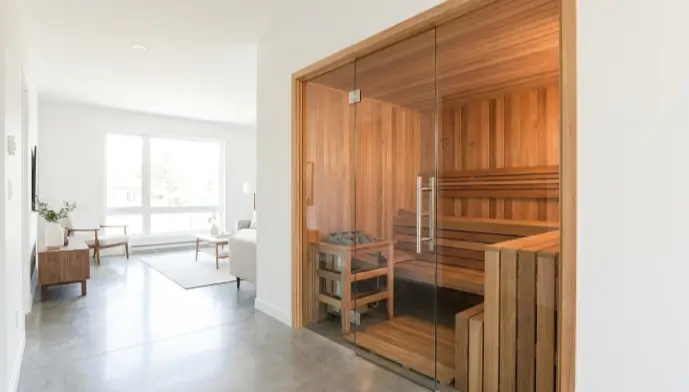
When a full-size cabin doesn’t fit the space, budget, or lease, the realistic alternatives are a one-person infrared cabinet, roughly the size of a shower stall, or a portable sauna blanket that needs no dedicated room at all. Both typically run on a standard 120V outlet, avoid the electrical work a larger cabin requires, and let apartment dwellers and renters get a meaningful heat session without a full installation.
What is the smallest standing sauna option that still feels like a real sauna?
A one-person infrared cabinet is the floor. These units need roughly 3 feet by 3 feet of floor space and about 6.5 feet of ceiling height, similar to a small shower enclosure, and several models are designed to be assembled and disassembled without tools, which matters if you’re not sure you’ll stay in the same home for years. They run cooler than a multi-person traditional cabin, typically 120°F to 140°F, and use infrared panels rather than heated air, so a 1.5 kW draw on a standard outlet is usually enough. For someone who wants a genuine seated sauna experience without committing a full room, this is the practical entry point.
What if even that doesn’t fit?
Below the cabinet tier, a portable sauna blanket is the next option. It’s essentially a heated, insulated wrap you lie inside, delivering infrared heat directly to your body while folded flat for storage between uses. It needs no dedicated floor space at all, just a spot to lie down, which makes it viable in a studio apartment or a room already used for other things. The experience is different from sitting upright in a cabin, and session length and heat distribution aren’t identical, but for someone whose main obstacle is square footage, it closes most of the gap.
Why do renters specifically gravitate toward these smaller options?
A full-size cabin with a 240V heater usually means new wiring, which most leases either prohibit outright or require landlord approval and reversal at move-out. A plug-in infrared cabinet or a sauna blanket sidesteps that entirely: no permit, no electrician, and nothing left behind when you move except normal wear on a standard outlet. That’s the practical reason these smaller formats show up so often in apartments and rentals rather than a scaled-down version of the same electrical planning a house owner would go through.
How does the experience actually compare to a full cabin?
A one-person cabinet gets closest to the real thing: you sit upright, the space heats around you, and session length of 20 to 40 minutes is comparable to a larger infrared cabin. A sauna blanket trades some of that whole-body ambient heat for pure convenience, since you’re lying down and wrapped rather than seated in a heated enclosure, and sessions tend to run a bit shorter, often 20 to 30 minutes. Neither replicates the high-heat, stone-and-steam intensity of a traditional multi-person cabin, and that’s a fair tradeoff to acknowledge rather than oversell, since buyers choosing between these formats are usually optimizing for space and simplicity over peak heat.
If you’re still deciding whether a compact cabinet or a full-size cabin makes more sense once you know your actual space constraints, it helps to compare footprint and electrical requirements across a few models rather than assuming a smaller unit is always the compromise choice. For that side-by-side view, one specialty retailer lists both compact and full-size indoor formats together, worth a look before you settle on either direction.
See also: The Clock Nobody Tells You About: What Peptide Trials Really Show for Men Over 40
What about a shared building sauna or a wellness studio membership instead?
Some apartment buildings and condo complexes include a shared sauna as an amenity, and for someone who isn’t ready to buy anything, that’s worth checking before spending on a personal unit. The tradeoff is availability and privacy: a shared amenity is often first-come, may have posted hours, and won’t be there if you move. A wellness studio membership or drop-in pass offers more schedule flexibility than a building amenity but usually costs more over a year than owning even a modest infrared cabinet, especially once you’re using it several times a week. For someone who saunas occasionally and doesn’t want a long-term commitment, either of these can make more sense than a personal unit. For someone who already knows they want it as a regular habit, the math tends to favor owning something, even a compact format, within the first year or two.
Are these smaller formats worth it, or should you wait until you have room for a full cabin?
For most people in this situation, starting smaller now beats waiting years for a bigger space. A systematic review of dry sauna bathing and a broader Mayo Clinic Proceedings review both describe cardiovascular and general wellness associations tied to regular sauna use, which points toward consistency mattering more than any single session’s intensity. An older review in The American Journal of Medicine reached a similar conclusion while also noting who should be cautious with frequent high-heat exposure regardless of format. None of these studies compare cabinet size to health outcome directly, but the broader pattern, that regular use is what the research actually tracks, is a reasonable case for choosing whatever format fits your space now rather than deferring the habit until a larger cabin becomes practical.
Frequently Asked Questions
What are the smallest indoor sauna options for a tight space?
A one-person infrared cabinet, roughly the footprint of a shower stall, is the smallest full-standing option. Below that, a sauna blanket or portable infrared wrap needs almost no dedicated space at all and stores in a closet between uses.
Can renters install any kind of indoor sauna?
Yes, with the right unit. A plug-in one-person infrared cabinet or a sauna blanket needs no permanent electrical work and no permission from a landlord in most cases, since it plugs into a standard outlet and can be removed at move-out.
Is a sauna blanket as effective as a full sauna cabin?
A sauna blanket delivers direct heat to the body similar to infrared panels but doesn’t create the same whole-room heat exposure. It’s a reasonable substitute when space or budget rules out a cabin, though the experience and session length differ.
How much space does a one-person infrared cabinet actually need?
Most one-person infrared cabinets need about 3 feet by 3 feet of floor space and roughly 6.5 feet of ceiling height, comparable to a small shower enclosure, making them viable in a bathroom corner or a converted closet.
Do compact sauna options still need a dedicated electrical circuit?
Generally no. Most one-person infrared cabinets and all sauna blankets are designed to run on a standard 120V household outlet, which is a major reason they work in apartments, rentals, and homes without spare electrical capacity.
References
- Cardiovascular and Other Health Benefits of Sauna Bathing: A Review of the Evidence, Mayo Clinic Proceedings, 2018
- Clinical Effects of Regular Dry Sauna Bathing: A Systematic Review, Evidence-Based Complementary and Alternative Medicine, 2018
- Benefits and risks of sauna bathing, The American Journal of Medicine, 2001
- UL Solutions, product safety standards
By Nina Sorbek

